
thumbnail image


  • Home
  • Image Processing IP 
    • HDR ISP IP Core
  • Automotive Products 
    • Camera Monitor System
    • Smart B-pillar
  • RGB-D Depth Cameras 
    • Okulo P1
    • Okulo C1
    • Okulo C2
  • Resources 
    • Computational Imaging Courses
    • Download Center
  • About Us 
    • Introduction
    • Careers
    • Contact Us
  • …  
    • Home
    • Image Processing IP 
      • HDR ISP IP Core
    • Automotive Products 
      • Camera Monitor System
      • Smart B-pillar
    • RGB-D Depth Cameras 
      • Okulo P1
      • Okulo C1
      • Okulo C2
    • Resources 
      • Computational Imaging Courses
      • Download Center
    • About Us 
      • Introduction
      • Careers
      • Contact Us
    Contact


    • Home
    • Image Processing IP 
      • HDR ISP IP Core
    • Automotive Products 
      • Camera Monitor System
      • Smart B-pillar
    • RGB-D Depth Cameras 
      • Okulo P1
      • Okulo C1
      • Okulo C2
    • Resources 
      • Computational Imaging Courses
      • Download Center
    • About Us 
      • Introduction
      • Careers
      • Contact Us
    • …  
      • Home
      • Image Processing IP 
        • HDR ISP IP Core
      • Automotive Products 
        • Camera Monitor System
        • Smart B-pillar
      • RGB-D Depth Cameras 
        • Okulo P1
        • Okulo C1
        • Okulo C2
      • Resources 
        • Computational Imaging Courses
        • Download Center
      • About Us 
        • Introduction
        • Careers
        • Contact Us
      Contact
      • Point Spread Frame-buffer-less HDR ISP IP Core

        High Performance · Low Power · DDR-less HDR ISP

        ·End-to-End Latency as Low as 3 ms

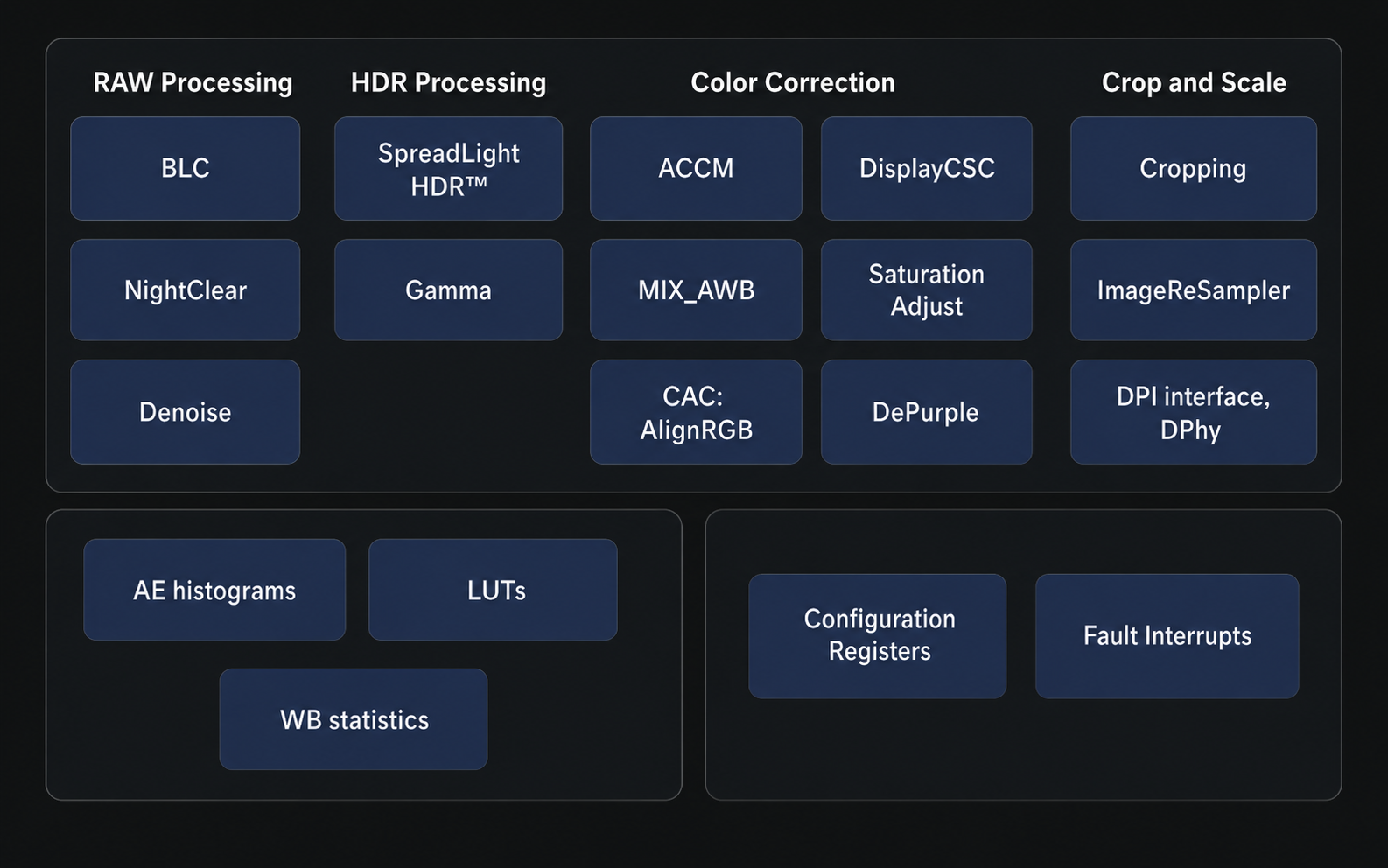
        Point Spread's Frame-buffer-less HDR ISP is an ISP IP Core designed for Smart CMOS Image Sensor (CIS) applications. It performs full-pipeline HDR image processing without an external DDR frame buffer, with end-to-end latency as low as 3 ms. This significantly reduces CIS module system cost and power consumption. It is ideal for latency- and power-sensitive imaging systems such as medical endoscopes, AR/MR glasses, automotive vision, and military or law-enforcement night vision.

      • What Is a Frame-buffer-less HDR ISP?

        A Frame-buffer-less HDR ISP is an image signal processor that does not rely on external DDR to store full image frames. Instead, it performs HDR merging and image-quality processing through a Line-to-Line pipeline. Conventional ISPs buffer multiple frames in DDR for HDR fusion and denoising, introducing tens of milliseconds of latency as well as higher BOM cost and system power consumption. Point Spread's Frame-buffer-less HDR ISP performs equivalent processing on-chip through a Deep Pipeline Architecture, processing 1 pixel/clock and supporting high-speed CIS readout.

        The IP is delivered as a modular solution. CIS vendors can enable, disable, or tune individual processing modules according to their pixel-array characteristics. It can be integrated directly into a CIS to create a “Smart CMOS Image Sensor (CIS),” or embedded in the imaging pipeline of a SoC or ASIC.

      • Core Features and Quantitative Metrics

        Section image

        Ultra-Low Latency

        Full-pipeline end-to-end processing latency as low as 3 ms, with Line-to-Line processing and no full-frame wait.

        Section image

        DDR-less HDR ISP

        Eliminates the external DDR frame buffer, directly reducing CIS module memory BOM cost, PCB area, and system power consumption.

        Section image

        High-Quality HDR

        Full-pipeline end-to-end processing latency as low as 3 ms, with Line-to-Line processing and no full-frame wait.

        Section image

        Single-frame RAW-domain Noise Reduction

        Single-frame RAW-domain Noise Reduction delivers ultra-low latency and produces low-noise images without multi-frame buffering.

        Section image

        Adverse-Scene Enhancement

        Built-in Rain & Haze Enhancement plus the NightClear™ Night-vision Enhancement Engine for challenging lighting conditions such as rain, haze, and nighttime scenes.

        Section image

        Deep Pipeline Architecture

        A Deep Pipeline Architecture processes 1 pixel/clock and supports high-speed readout.

        Section image

        Modular and Configurable

        IP modules can be flexibly enabled, disabled, and parameterized to suit CIS pixel-array characteristics, allowing area and power to be optimized for each design.
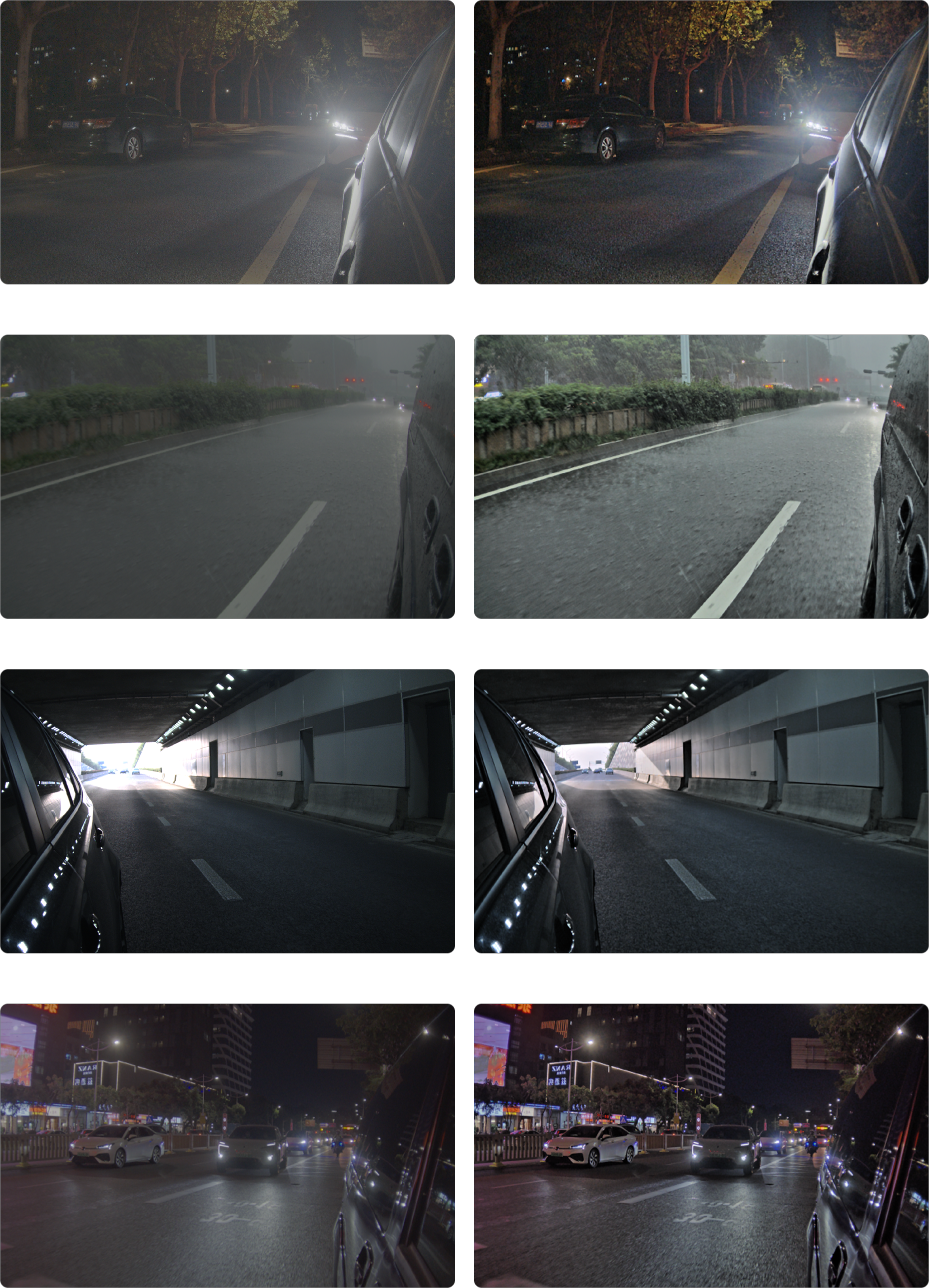
      • Real-World Image Quality Comparisons in Challenging Scenes

        In real-world, same-condition comparison tests covering complex nighttime lighting, rain, haze, and low-light scenes, the Point Spread Frame-buffer-less HDR ISP produced lower noise, more complete highlight and shadow detail, and a wider usable dynamic range. Four representative scene comparisons are shown below:
      • Core IP: Real-time 4K RAW-domain BM3D Denoising IP Core

        Why Is Real-Time BM3D So Difficult for the Industry?

        BM3D is an advanced version of non-local means (NLM) and is widely recognized for best-in-class denoising performance as measured by PSNR. However, its computational complexity is extremely high, so it is usually limited to offline processing. BM3D is based on non-local block matching: it first searches for similar blocks. NLM averages those blocks, while BM3D groups them in a transform domain and applies collaborative filtering. The filtered group is then inverse-transformed and aggregated with weighting to produce the denoised target block. BM3D is particularly complex because it must search for similar blocks and perform two block-wise estimation stages, roughly doubling the complexity of NLM while also introducing transform-domain operations. Point Spread provides deeply optimized real-time RAW-domain hardware IP that is straightforward to integrate.

        Point Spread's Real-Time Hardware Implementation and Specifications

        Point Spread has introduced a Real-time 4K RAW-domain BM3D Denoising IP Core that implements this traditionally offline algorithm in real-time hardware, bringing DSLR-class denoising quality to real-time imaging devices such as smartphones and endoscopes. It improves video denoising performance by 30%, significantly reduces noise in low-light scenes, and can be embedded directly into a RAW-domain processing pipeline for easy integration.
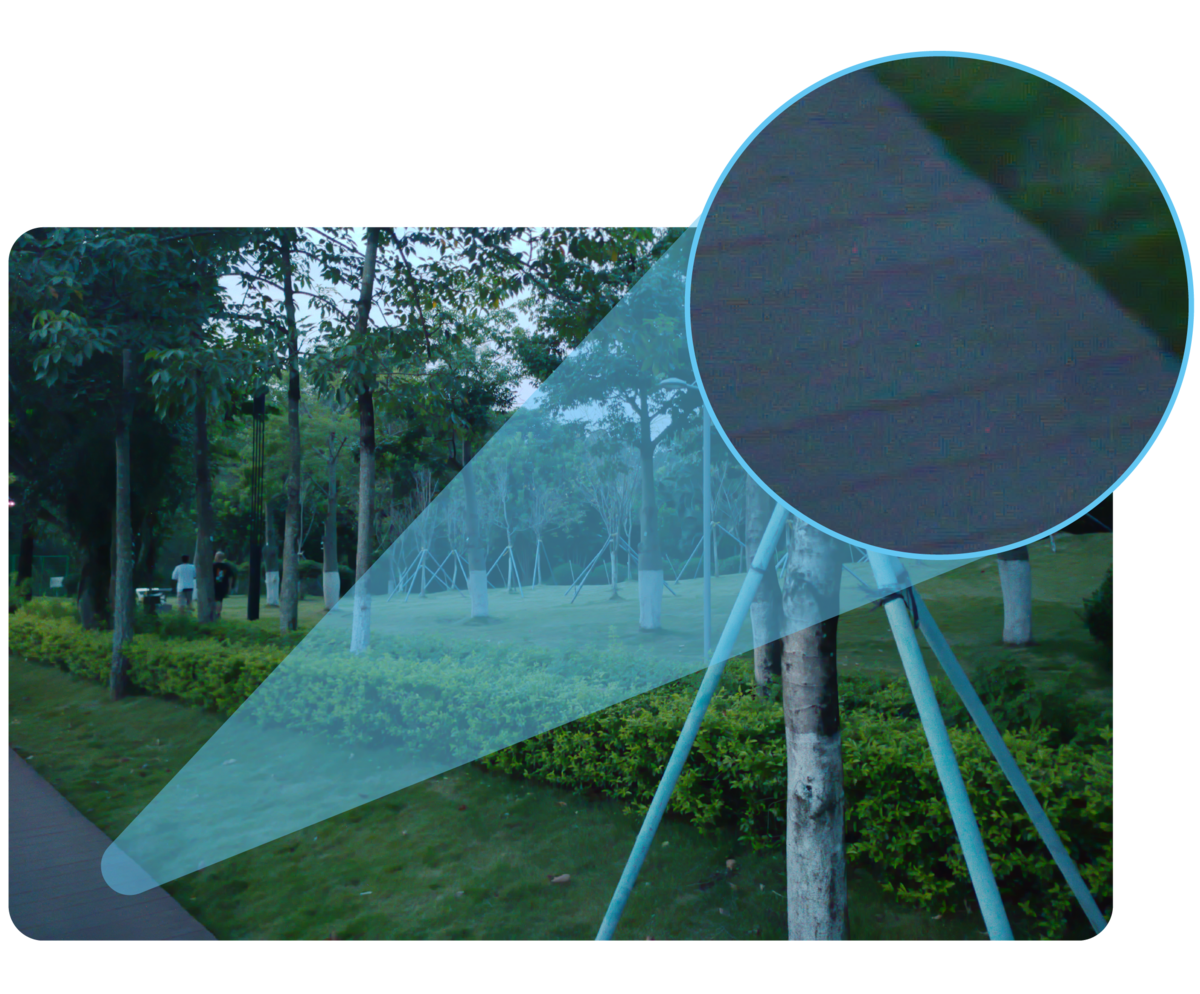
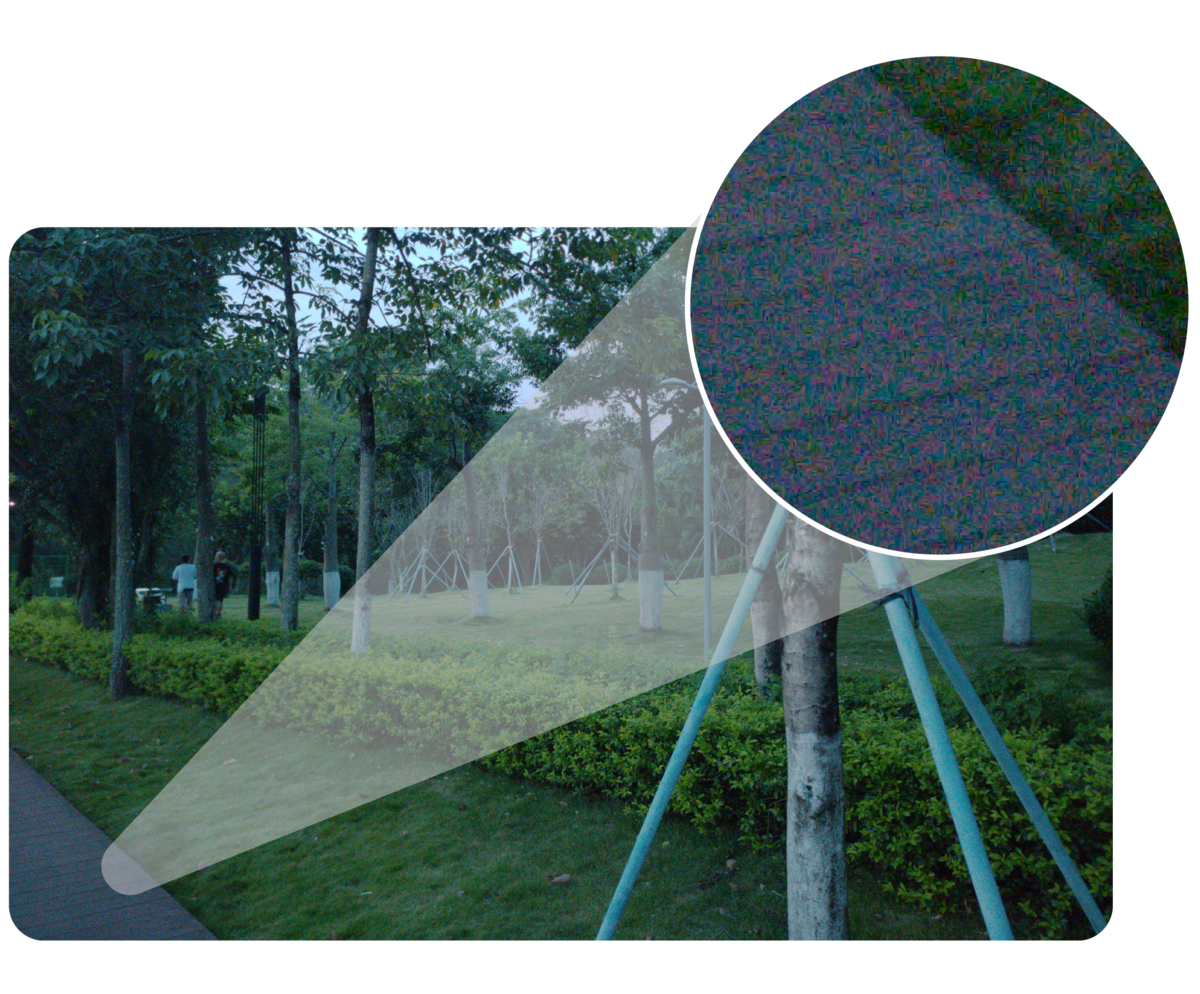
        Before denoising (left, noisy image) and after BM3D IP processing (right, result). Test conditions: single-frame capture; 1/2-inch IMX586; F/1.7; 0.8 μm pixel size.

        *Note: Area data is estimated for a 7 nm process; FPGA data comes from a validation instance. Exact test conditions are annotated on the original images to support reproducible customer evaluation.

      • Applications and Target Customers

        The Point Spread Frame-buffer-less HDR ISP is designed for imaging systems that are highly sensitive to latency, power, and cost:

        • CIS image sensor vendors (ISP IP licensing and integration): Vendors can integrate the IP directly into their sensors to output high-quality HDR images and create differentiated Smart CMOS Image Sensor (CIS) products.
        • Low-latency display for medical endoscopy: Gastrointestinal, respiratory, and neuroendoscopic procedures require extremely low display latency. End-to-end processing in 3 ms supports the surgeon's hand-eye coordination.
        • Processing ASICs for AR/AI/MR glasses: The DDR-less HDR ISP architecture significantly reduces ASIC power consumption and size, making it suitable for battery-powered headsets.
        • Military and law-enforcement low-latency night vision: NightClear™ Night-vision Enhancement Engine and low latency support electronic rear-view mirrors, night-vision devices, night-vision helmets, and related equipment.
        • Intelligent driving and automotive vision: Automotive vision and camera monitor systems (CMS) impose strict requirements on both latency and image quality in adverse weather. The Rain & Haze Enhancement function addresses these conditions directly.
        • Other applications: Robots and autonomous mobile equipment, drones and airborne vision, intelligent security monitoring, consumer electronics, and AIoT.

      • Frequently Asked Questions (FAQ)

        Q: How does a Frame-buffer-less (DDR-less) HDR ISP differ from a conventional ISP?

        A: Conventional HDR ISPs rely on external DDR to buffer multiple frames for fusion, typically introducing tens of milliseconds of latency while increasing BOM cost and power consumption. Point Spread's Frame-buffer-less HDR ISP performs single-frame HDR and denoising on-chip through a Line-to-Line pipeline, achieving end-to-end latency as low as 3 ms without external DDR.

        Q: Can BM3D denoising run in real time?

        A: BM3D has traditionally been limited to offline processing because of its high computational complexity. Point Spread has implemented it as a Real-time 4K RAW-domain BM3D Denoising IP Core, using only 0.5 MB of on-chip RAM per 4K frame and approximately 1 mm² at 7 nm (estimated). It has been validated on FPGA using 250K–400K LUTs.

        Q: Why do medical endoscopes require a low-latency ISP?

        A: Intraoperative display latency directly affects a physician's hand-eye coordination and procedural safety. Point Spread's 3 ms full-pipeline end-to-end latency is well below the human perceptual threshold and supports low-latency display requirements for gastrointestinal, respiratory, and neuroendoscopy.

        Q: Is this ISP IP suitable for AR/MR glasses?

        A: Yes. ASICs for glasses are highly sensitive to power and area. The DDR-less HDR ISP architecture eliminates external memory and its power consumption, while the Deep Pipeline Architecture can be scaled to the required silicon area. It provides a direct low-power imaging-pipeline solution for head-mounted devices.

        Q: How can the IP be evaluated and integrated?

        A: The IP is delivered in modular form and supports FPGA prototyping. CIS vendors can configure module parameters for their pixel-array characteristics and embed the IP in a RAW-domain processing pipeline, or license the complete solution for integration into a sensor or SoC.

      Copyright © 2020 - 2024 PointSpread. All Rights Reserved. 点昀技术(南通)有限公司 版权所有

      苏公网安备 32060102320784号
      |
      苏ICP备2022041483号-2
        pointspread
        Pointspread Technology is committed to revolutionizing the field of computational photography and computational optics with the world's leading computational imaging technology. We are committed to revolutionizing the field of computational photography and computational optics with the world's leading computational imaging technology, driving revolutionary advances in consumer electronics, automotive, and industrial imaging. Pointspread Technology introduces the latest RGBD camera, Okulo P1, which supports up to 120 fps aligned color point cloud output, ultra-low latency, and industrial grade IP67 protection.
        https://user-assets.sxlcdn.com/images/1016220/Fh20mgywRnTUMSfSGqp3tmdybRwq.png?imageMogr2/strip/auto-orient/thumbnail/1200x630>/format/png
        Cookie Use
        We use cookies to ensure a smooth browsing experience. By continuing we assume you accept the use of cookies.
        Learn More