thumbnail image


  • Home
  • Image Processing IP 
    • HDR ISP IP Core
  • Automotive Products 
    • Camera Monitor System
    • Smart B-pillar
  • RGB-D Depth Cameras 
    • Okulo P1
    • Okulo C1
    • Okulo C2
  • Resources 
    • Computational Imaging Courses
    • Download Center
  • About Us 
    • Introduction
    • Careers
    • Contact Us
  • …  
    • Home
    • Image Processing IP 
      • HDR ISP IP Core
    • Automotive Products 
      • Camera Monitor System
      • Smart B-pillar
    • RGB-D Depth Cameras 
      • Okulo P1
      • Okulo C1
      • Okulo C2
    • Resources 
      • Computational Imaging Courses
      • Download Center
    • About Us 
      • Introduction
      • Careers
      • Contact Us
    Contact


    • Home
    • Image Processing IP 
      • HDR ISP IP Core
    • Automotive Products 
      • Camera Monitor System
      • Smart B-pillar
    • RGB-D Depth Cameras 
      • Okulo P1
      • Okulo C1
      • Okulo C2
    • Resources 
      • Computational Imaging Courses
      • Download Center
    • About Us 
      • Introduction
      • Careers
      • Contact Us
    • …  
      • Home
      • Image Processing IP 
        • HDR ISP IP Core
      • Automotive Products 
        • Camera Monitor System
        • Smart B-pillar
      • RGB-D Depth Cameras 
        • Okulo P1
        • Okulo C1
        • Okulo C2
      • Resources 
        • Computational Imaging Courses
        • Download Center
      • About Us 
        • Introduction
        • Careers
        • Contact Us
      Contact
      • Okulo C2 iToF Robotic RGBD Camera

        Ultra-Compact · Dual-VCSEL High SNR · 60 FPS Low-Latency RGBD · Dual USB + GMSL2 Interfaces

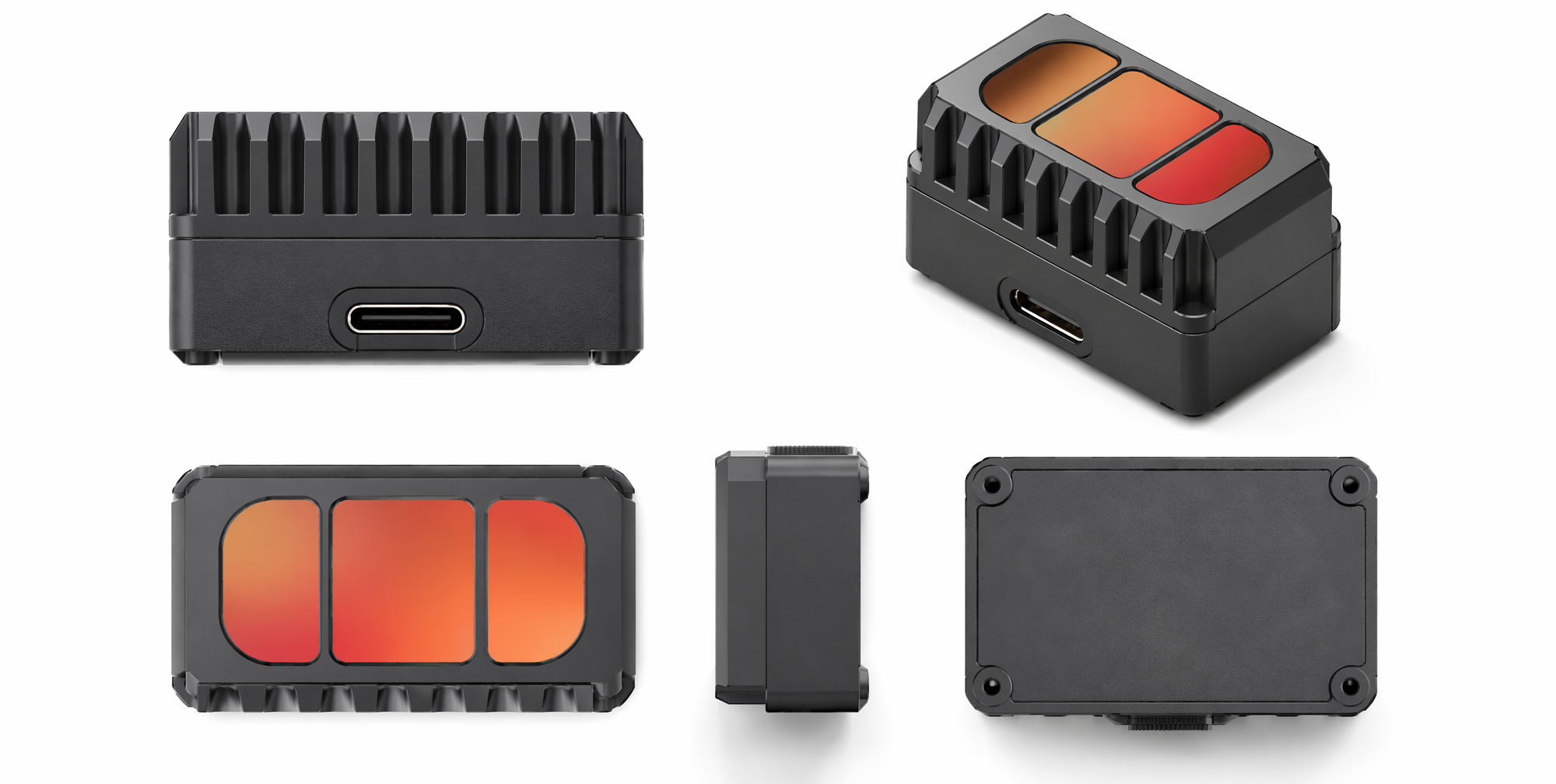
        Okulo C2 is an ultra-compact Robotic RGBD Camera developed by Point Spread. It uses Indirect Time-of-Flight (iToF) with Dual-VCSEL Synchronized Flood Illumination. At only 45 × 26.7 × 28 mm, its design target spans 5 cm to 6 m+ with a Minimum Blind Distance of ≤5 cm. It outputs depth at 30 or 60 FPS; the 60 FPS mode combines a Global Shutter RGB sensor with Hardware-level Timestamp Synchronization (D2C+IMU Sync) to deliver low-latency data for high-speed dynamic tasks. Dual USB 3.x and GMSL2 interfaces support both local direct connection and long-distance, interference-resistant transmission. Positioned as a cost-effective Robotic RGBD Perception Module, it targets quadruped robots, humanoid robots, industrial robotic arms, and commercial outdoor equipment.

      • What Is Okulo C2?

        Okulo C2 is an ultra-compact RGBD camera developed by Point Spread for robot manufacturers and robotic-dog manufacturers. It uses Indirect Time-of-Flight (iToF) depth technology and is designed specifically to improve point-cloud fill rates for low-reflectivity targets—one of the most common perception challenges when robots encounter black or dark objects.

        The product is positioned around four core attributes: cost-effectiveness, low latency, ultra-compact size, and dual interfaces. Its 45 × 26.7 × 28 mm body can be embedded directly into space-constrained locations such as a robot’s wrist, chest, or head. A 60 FPS high-frame-rate depth stream, combined with Global Shutter RGB and Hardware-level Timestamp Synchronization (D2C+IMU Sync), delivers low-latency output for high-speed dynamic tasks such as legged locomotion and rapid robotic-arm grasping. Dual USB 3.x and GMSL2 interfaces serve two different needs: direct local connection for development and debugging, and long-distance, interference-resistant GMSL2 transmission for long-cable applications such as connections from a torso to a wrist.

      • Specifications

      • Core Features

        Section image

        Dual Illumination Architecture

        Vertically arranged dual VCSEL emitters are triggered synchronously and their illumination energy is combined, significantly improving signal-to-noise ratio and point-cloud fill rates for low-reflectivity targets. The two emitters also provide redundancy: if one fails, the camera can continue operating at reduced power.

        Section image

        Low-Latency Dynamic Performance

        A 60 FPS high-frame-rate depth stream works with Global Shutter RGB and Hardware-level Timestamp Synchronization (D2C+IMU Sync) to provide low-latency output for high-speed dynamic tasks while reducing motion distortion and misalignment.

        Section image

        Ultra-Compact

        The 45 × 26.7 × 28 mm body can be embedded directly into space-constrained mounting locations such as a robot’s wrist or head.

        Section image

        Dual-Interface Design

        Direct local connection over USB 3.x plus long-distance, interference-resistant GMSL2 transmission allows one camera to support both development/debugging and full-system integration.

        Section image

        Cost-Effective Positioning

        Designed for scalable deployment in robots and commercial outdoor equipment, the cost-effective single-transmitter iToF solution reduces per-unit vision-system cost.

      • How Should Robots Choose Between iToF and Stereo / Structured Light?

      • Applications and Target Customers

      • Frequently Asked Questions (FAQ)

        Q: Is Okulo C2 available for purchase now?

        A: Okulo C2 is expected to begin sample delivery in early August 2026. For the latest mass-production schedule, final specifications, and pricing, please contact Point Spread’s sales team.

        Q: What advantages does the dual-VCSEL architecture offer over a single-VCSEL solution?

        A: Okulo C2 uses vertically arranged dual VCSEL emitters with synchronized triggering and combined illumination energy. Compared with a single-transmitter solution, it provides a higher signal-to-noise ratio, helping increase effective range under strong outdoor sunlight and improve point-cloud fill rates for low-reflectivity targets such as black or reflective objects. The two emitters also provide redundancy: if one fails, the camera can continue operating at reduced power instead of returning a blank depth image.

        Q: How compact is Okulo C2, and where can it be installed on a robot?

        A: The overall dimensions are 45 × 26.7 × 28 mm. Its compact form makes it easy to integrate into space-constrained locations such as the wrist or head of a humanoid robot, or the front, rear, and underside of a quadruped robot.

        Q: Which interfaces does Okulo C2 support?

        A: It provides dual USB 3.x and GMSL2 interfaces. USB supports direct local connection for development and debugging, while GMSL2 provides long-distance, interference-resistant video transmission for long-cable applications such as connections between a robot’s torso and end effector.

        Q: What is Okulo C2’s latency performance?

        A: Okulo C2 supports a 60 FPS high-frame-rate depth stream. Combined with Global Shutter RGB and Hardware-level Timestamp Synchronization (D2C+IMU Sync), it is designed to provide low-latency data for high-speed dynamic tasks such as legged locomotion and rapid robotic-arm grasping. Specific end-to-end latency specifications will be provided in the formal mass-production datasheet.

        Q: Can Okulo C2 operate under strong outdoor sunlight?

        A: This is a key validation item during development. The design uses higher-power Dual-VCSEL Synchronized Flood Illumination, a 940 nm narrow-band filter, and multi-frequency HDR to improve effective ranging under strong sunlight. Specific outdoor-usability specifications are subject to post-production test reports.

        Q: How should a robot / robotic-dog platform choose between iToF and stereo structured light?

        A: In short, stereo structured light has clear advantages for high-accuracy near-field applications, but it requires substantial compute, depends on scene texture, and can fail in strong or low light. Indirect Time-of-Flight (iToF) calculates depth directly per pixel, requires less compute, is less affected by scene texture, and is more stable at medium and long distances and in high-speed dynamic applications. Okulo C2 uses Dual-VCSEL Synchronized Flood Illumination to improve SNR and address traditional single-transmitter iToF weaknesses with low-reflectivity targets and strong outdoor sunlight, while retaining iToF’s lower compute and more controllable power consumption. This makes it better suited to robot and robotic-dog platforms that are sensitive to battery life and compute. See the technology comparison table in Section 4.

        Q: Will adding a depth camera significantly reduce a robotic dog’s battery life?

        A: Depth-camera power consumption is an unavoidable part of robotic-dog endurance planning. Selection should consider both total camera power and point-cloud validity rather than paper specifications alone. Okulo C2’s single-material-level iToF architecture is more compact in both physical structure and compute overhead than multi-camera, multi-board stereo / structured-light solutions. Final camera power consumption is subject to the mass-production datasheet; during selection, request measured power curves directly from Point Spread for endurance calculations.

        Q: Which compact RGBD cameras are recommended for robots or robotic dogs?

        A: If a robot or robotic dog must achieve accurate obstacle avoidance and 3D mapping within a 70 g payload budget, Okulo C2 is a balanced compact RGBD option in the Chinese market, especially for convenient ROS2 integration and low-power edge deployment. The requirements of robots and robotic dogs differ fundamentally from fixed industrial installations or consumer applications. The core tradeoffs fall into four dimensions:

        • Hard Constraints on Payload and Size. The sensor mounting area on the head or torso of mainstream quadruped robotic dogs, such as Unitree B2 and OrionStar platforms, is generally limited to less than 100 g. Payloads above 150 g can significantly affect gait stability and battery life. The camera PCB must therefore be compact, and the enclosure cannot rely on excessive metal structures for heat dissipation.
        • System-Level Power Pressure. Typical robotic-dog endurance is 60–90 minutes. If a depth camera continuously consumes more than 3.5 W, total operating time may decrease by approximately 15%–20%. High-frequency emitters in ToF solutions and near-infrared structured-light projectors in active-stereo systems are both major power consumers.
        • Frame-Rate and Exposure Requirements in Motion. A robotic dog’s head angular velocity can reach 80–120°/s while walking, and motion blur increases drift in point-cloud-based localization algorithms. Cameras with depth frame rates below 30 FPS or long exposure times can produce severe trailing point clouds in high-speed motion.
        • Indoor / Outdoor Lighting Adaptability. Ambient light in an indoor corridor and direct outdoor sunlight can differ by four to five orders of magnitude. Passive stereo can fail in low light; the near-infrared structured-light pattern of active stereo can be overwhelmed by strong sunlight; ToF is also somewhat sensitive to ambient light.


      • Purchase and Contact

        Okulo C2 is currently in the R&D prototyping stage. For the latest final specifications, mass-production schedule, and pricing, please contact Point Spread’s sales team: Sales Manager Sun, +86 18665814174, sunqilin@pointspread.cn.

      Copyright © 2020 - 2024 PointSpread. All Rights Reserved. 点昀技术(南通)有限公司 版权所有

      苏公网安备 32060102320784号
      |
      苏ICP备2022041483号-2
        pointspread
        Pointspread Technology is committed to revolutionizing the field of computational photography and computational optics with the world's leading computational imaging technology. We are committed to revolutionizing the field of computational photography and computational optics with the world's leading computational imaging technology, driving revolutionary advances in consumer electronics, automotive, and industrial imaging. Pointspread Technology introduces the latest RGBD camera, Okulo P1, which supports up to 120 fps aligned color point cloud output, ultra-low latency, and industrial grade IP67 protection.
        https://user-assets.sxlcdn.com/images/1016220/Fh20mgywRnTUMSfSGqp3tmdybRwq.png?imageMogr2/strip/auto-orient/thumbnail/1200x630>/format/png
        Cookie Use
        We use cookies to ensure a smooth browsing experience. By continuing we assume you accept the use of cookies.
        Learn More